
0
Logged crossingsSailings ridden with a notebook: wait times, boarding order, and where people actually sat once the boat was full.

The water leg is not a line on a ticket. It is a sequence: when to arrive, how to board, where to stand, and what to do if the sailing is pulled.
Regular passengers already know that order and rarely say it out loud. We write it down. gabbroidic prepares walk-on and vehicle crossings so the pier, the deck, and the hour after you step off stay under your control — including the days when wind cancels the boat and the arrival dock sits far from the place you actually need to be.
Learn MoreA waterfront promenade is staged. A ferry slip is not. Who waits, what they carry, and how the line forms are the first accurate pages of the place you are entering.
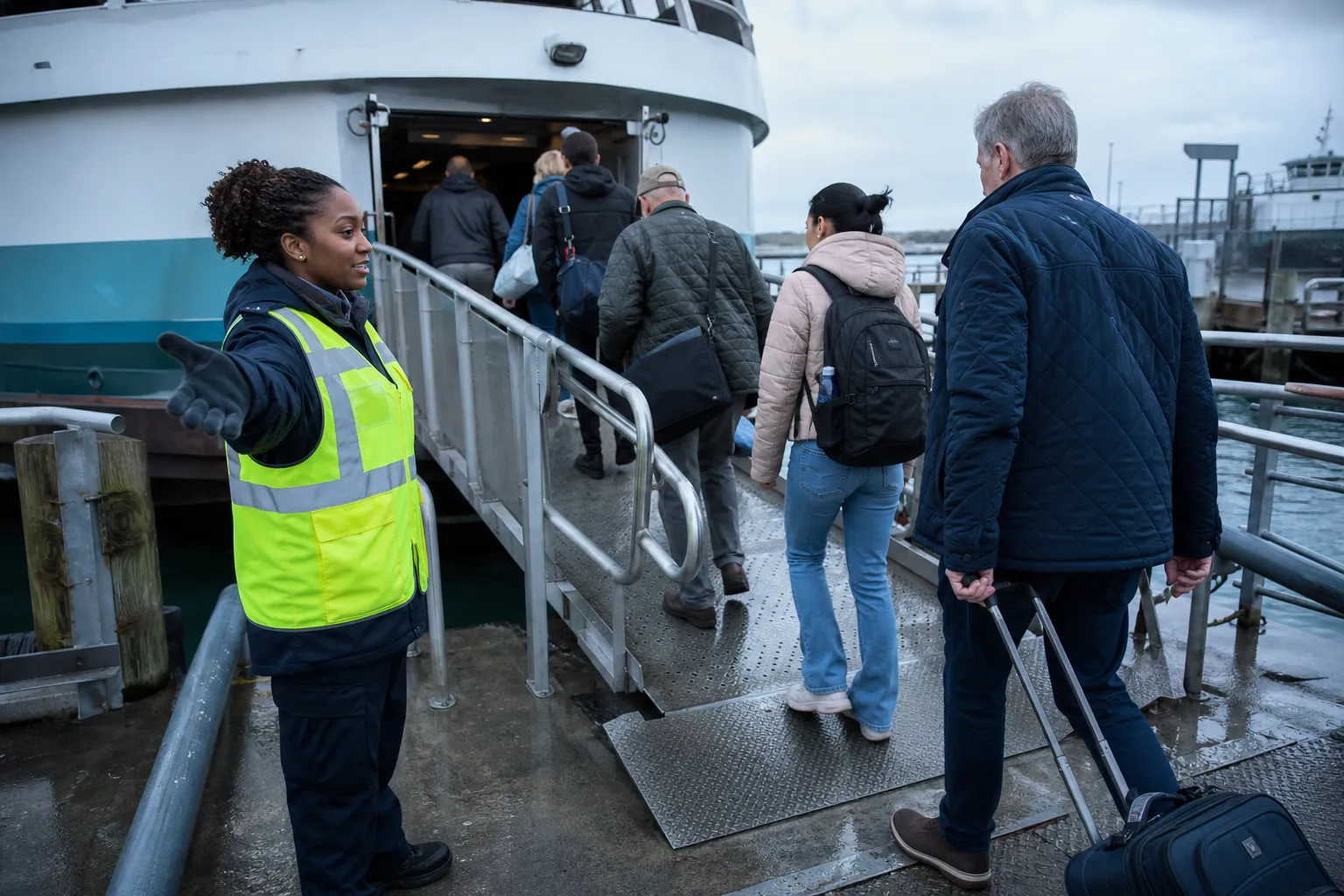
People who live along a channel treat the boat the way others treat a bus: they know which sailing is for work, which one is for errands, and which one is already full of visitors with rolling cases. If you only meet the coast from a viewpoint, you miss that distinction. On the slip you see it immediately — grocery crates, school backpacks, a bicycle with a damp cover, a van that has done this loading a hundred times.
That is why we ask travellers to treat the water leg as a place, not a connector. The hour on board is when the coast explains itself without a caption. It is also where a small mistake — standing in the vehicle lane, occupying a crew gap, filming a docking that needs quiet — marks you as someone who has not learned the room yet.
A twelve-person launch, a three-deck passenger ferry, and a drive-through car boat do not share a layout, but they share a logic. There is a waiting mark, a point of no return, a place for bulky bags, and a side of the vessel the crew wants clear. The launch may have no cabin and no toilet. The passenger ferry may have a closed salon that fills before the open deck. The car ferry may board vehicles in a different order from foot passengers and discharge them in yet another.
We compare those layouts so you know what “arriving forty minutes early” actually means on the boat you booked — not on a generic terminal diagram. The common thread is not comfort. It is sequence. Once you can name the sequence, the rest of the day is much harder to knock over.
Timetables list departures. They do not list the unwritten queue, the separate gate for vehicles, or the reason a polite latecomer is still left on the pier.
On most crossings the cut-off is physical: once the ramp is up, there is no second door. Regulars reach the slip early enough to park a bag, use a restroom that may be outside, and still be in the marked lane when names or tickets are checked. A delay that a railway might absorb becomes a missed sailing here, and the next boat may already be full.
Foot passengers often thread a side gate while cars stack in a painted grid. Mixing those lines is how people get shouted at. If you are on foot, do not drift toward the vehicle bow. If you are driving, stay in the vehicle until a marshal tells you to leave the cabin — and know where the passenger stairs will be after you park on the deck.
Large cases usually go in a rack, a hold, or against a marked bulkhead. What you keep should fit at your feet without blocking a corridor. On short hops people try to sit on their luggage in the aisle; crew will move you. On longer passages the risk is the opposite: you leave a bag in a rack and walk off a different door than you boarded.
There are spots along the rail and at the bow that look empty and are not. They are working space. Regulars leave them. They also keep voices down in a closed salon, save loud calls for the open deck, and ask before photographing a docking. None of that is printed on the ticket. All of it is visible in the first five minutes if you watch who already belongs there.
These numbers come from crossings the team rode, sketched, and later used in briefings. They are a record of fieldwork, not a scoreboard.
0
Logged crossingsSailings ridden with a notebook: wait times, boarding order, and where people actually sat once the boat was full.
0
Vessel layouts comparedFrom open launches to double-ended car boats — enough variety to show what transfers between types and what never does.
0
Years of regular ridingA working span long enough to see the same slips in low season and in the weeks when there is no seat left on deck.
0
Briefing outlines each seasonWritten sequences we reuse in consultations: first crossing, vehicle boarding, cancellation buffers, and landing connections.
Once you are aboard, the remaining choices are practical: where to stand, what you still need, when the sailing disappears, and how the first crossing should be built.
Locals often take the lee side and a seat that is dull on a postcard. Visitors take the view and then cannot hold a cup. Wind, spray, and the direction of docking decide more than upholstery. If you need to work or rest, the closed salon is quieter — until it is standing room only, which happens earlier than the open deck fills.
Short hops may have a kettle and nothing else. Longer passages may have a counter that closes before the last sailing. Pack for the gap: water, a layer that blocks wind, and any medication you already use, packed in a bag that stays with you. Leave the bulky “just in case” kit in the rack. If you are unsure about motion or health limits, that question belongs to a clinician, not to a travel page.
Wind, fog, and swell can cancel a sailing with little notice. Check the operator’s channel the evening before and again on the way to the slip. Keep the rest of the day movable: a bus that leaves from a dock miles outside town will not wait, and a hotel hold is easier to shift than a fixed tour slot. If the boat is pulled, eat, wait, or turn back — do not invent a crossing the crew has already refused.
Start with a daylight sailing, a walk-on ticket, and a route you can miss without collapsing the week. After you land, assume the port is not the town. Build a transfer with slack, write down the door you intend to leave by, and treat the first trip as a rehearsal for the longer one. Quiet on the salon, short greetings on deck, and no argument with crew: that is the whole etiquette list.
Three practitioners, three notebooks. They still take the boats they write about, then turn the notes into briefings you can actually follow.
Crossing Sequence Advisor
Passenger Boarding Briefing Credential, Harbor Passage Study Group
Mara times queues, gates, and the moment a ramp actually closes. She specialises in first crossings and in groups that need a walk-on plan that will still work if one person is late.

Vessel Layout Specialist
Small-Craft and Car-Ferry Layout Credential, Coastal Deck Institute
Jonah maps cabins, vehicle decks, and the dead space crew need at bow and stern. Travellers come to him when the question is where to stand, where a van goes, and which door they will actually leave by.

Timetable and Weather Researcher
Coastal Operations Observation Certificate, Open Channel Archive
Nia watches cancellations, substituted boats, and the gap between a published timetable and what ran. She builds the buffers that keep a landing from colliding with a bus that will not wait.
These are ordinary trips, told without varnish: crowded decks, pulled sailings, and the small corrections that kept the day usable.
If you already have dates and a vessel in mind, we can walk through boarding, bags, weather buffers, and the hour after you step off. If you are still choosing a first crossing, we will start smaller: daylight, walk-on, and a landing you can miss without undoing the week.
Request a Consultationgabbroidic treats the crossing as a practised sequence, not a promise of an easy passage. We ride the slips we describe, compare notes with the Harbor Passage Study Group, and turn those notes into briefings and one-to-one consultations. We will not sell you a platform or a ticket. We will tell you what the queue, the deck, and the cancellation usually look like — and what to confirm again before you travel, because the next sailing will not be a copy of the last one.
Contact Usgabbroidic provides information and briefings about passenger water crossings. The materials on this site are meant to help you understand how boarding, decks, bags, weather, and landing connections typically work, and to support consultations about that part of a trip. They are not a substitute for the operator’s current instructions, for local rules on the day you travel, or for professional advice outside our field.
We do not describe sea air, motion, or time on deck as a health treatment. Questions about wellbeing, motion sickness, pregnancy, disability access beyond what an operator publishes, or any medical contraindication belong with qualified specialists. A travel briefing cannot assess those issues and should not be asked to.
Conditions change between sailings. Timetables are rewritten, vessels are substituted, gates move, and a slip that had a roof last season may not have one now. Arrival ports often sit outside the settlement you named in the itinerary. Confirm times, baggage rules, vehicle cut-offs, and connections directly with the operator and with the next carrier before you leave home, then again on the day.
You remain responsible for the choices you make: which sailing you book, how much slack you leave, whether you travel with a vehicle, and what you do if the boat is cancelled. gabbroidic can prepare you for those decisions. We cannot take them for you, and we cannot guarantee that a crossing will run, that a deck will have a seat, or that a connection after landing will still exist when you step onto the ramp.